Can AI beat a naive portfolio? An experiment with anonymized data
Finance Research Letters v. 78 2025
EA-UFRGS
2025-11-04
Introduction
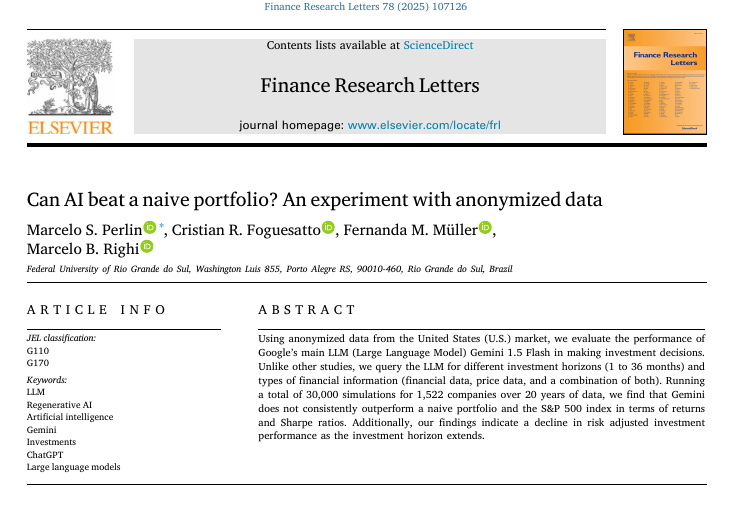
Paper published in FRL 2025 78
Introduction
Large Language Models (LLMs) like Gemini and ChatGPT are transforming many fields, including finance.
- Promise: LLMs can process vast amounts of unstructured data (news, reports, text) to inform investment decisions.
- Prior Research: Several studies show positive results, suggesting LLMs can help in:
- Asset selection and diversification (Ko and Lee 2024)
- Predicting future earnings (Pelster and Val 2024)
- Sentiment analysis of news (Kirtac and Germano 2024)
Too much hype?
A critical flaw in many existing studies is the use of non-anonymized data.
- LLMs are black box models, trained on vast amounts of historical internet data.
- If a study tests an LLM on 2010-2020 data, the LLM may remember that, for example, Apple was a good investment.
- This is a clear case of data leakage
Research Question
Can Google’s Gemini LLM consistently outperform simple benchmarks in a truly blind test using anonymized data?
Key Contributions:
Novel Blind Experiment: we omit any indication of stock ticker or time period of analyzed data
Heteregenous Inputs: We test across different data types (financials vs. prices) and time horizons (1 to 36 months).
Large Scale: We run 30,000 simulations using 20 years of data from 1,522 U.S. companies.
Data and Methods
Data
We use real financial statements and daily stock prices of U.S. companies from 2004 to 2024 (data from EODHD)
All stock prices are adjusted for dividends, splits, and any other corporate event
Based on the financial data, we follow an algorithm o build pdfs that are later analyzed by the LLM
The Sampling Algorithm (1/2)
A random date between 2004 and 2023 is selected using uniform probabilities;
Based on the previous date, we randomly select 5 stocks from a sample of companies that respect all the following rules:
- Prices and a history of financial documents (income statement, balance sheet, and cash-flow statement) from the last 5 years, counting from the random date, must be available;
- There must be no penny prices (lower than 1 USD) in the past 5 years of price history;
- In the past 5 years, the stock is traded with a daily average of financial volume higher than 250,000 dollars.
The Sampling Algorithm (2/2)
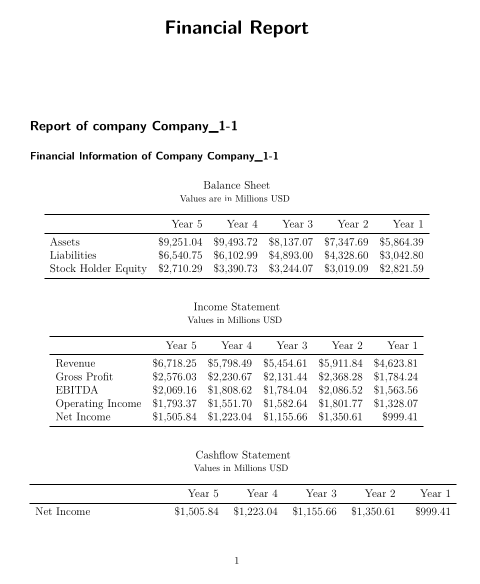
With the 5 random stocks from previous step, we use Quarto to build a single pdf with past information for the 5 selected companies in the previous 5 years, with three versions of the file:
- only-financials: a pdf version with only financial information (major registries in the Income Statement, Balance Sheet, and Cashflow statement);
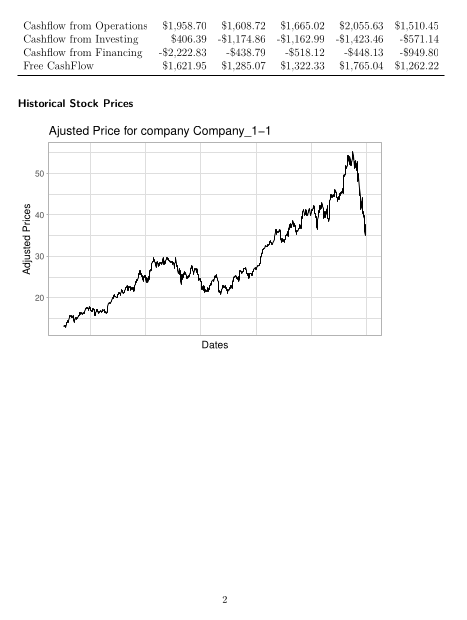
- only-prices: a version with only past adjusted prices of the stock, presented as a figure in the pdf;
- prices-and-financials: a version with financial information and past prices.
All numerical data (prices, revenue, income, etc.) are multiplied by a single random factor (e.g., 0.453). Company names are replaced for generic names (e.g., “Company_1-1”). All dates are removed.
We than feed the LLM with the built pdf and ask it how much to invest (exact query later)
Example of pdf
The Query
System instructions: You are a financial analyst with expertise in analyzing the past performance of companies and picking winning stocks. In this task, you are analyzing past information about 5 publicly traded companies.
Prompt: Today, you have 10,000 USD to invest for the next N-MONTHS months. You have 6 choices, 5 companies traded in the financial exchange, or invest in the risk-free rate named RISK-FREE-ASSET, which is currently yielding RF-YIELD of return per year. Return the response as json, with 6 elements, with the following structure in each element: “company”, “investment”.
N-MONTHS: placeholder for the investing horizon in months.
RF-YIELD: The current future yield rate. We use the most recent yield rate of the 5-year U.S. Treasury yield (ticker FVX) available on a random date from the simulation.
Benchmarks and Metrics
Benchmarks:
- S&P 500 Index: The standard market benchmark.
- Naive Portfolio: An equal-weight (1/N) portfolio.
Key Metrics:
- Annualized Return: Total portfolio profit per year.
- Sharpe Ratio: Risk-adjusted return.
- Alpha from market model: Measures consistent, statistically significant outperformance.
Results
Investiment Performance
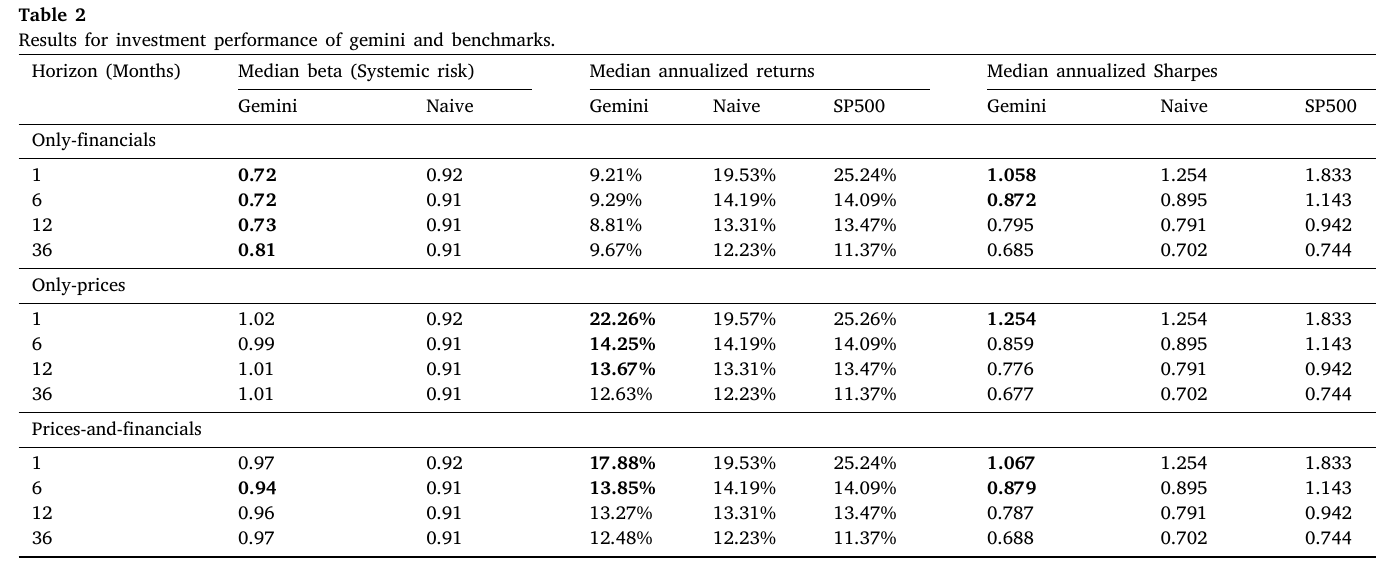
Table 02 - Results for investment performance of gemini and benchmarks.
Proportion results
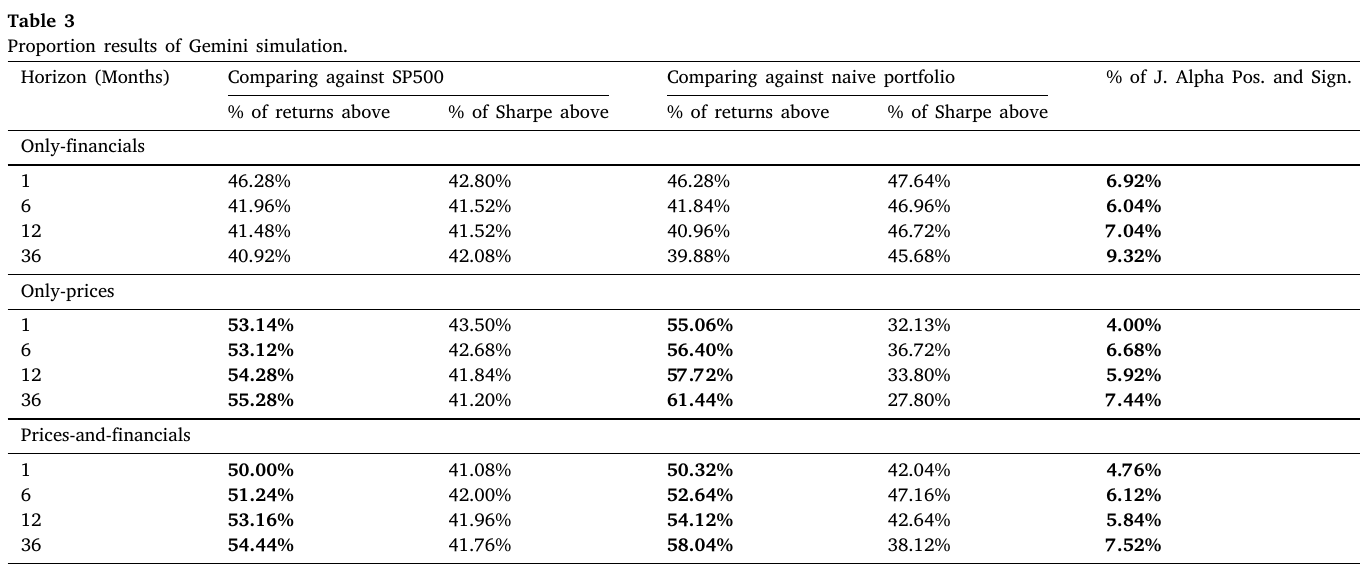
Table 03 - Proportion results of Gemini simulation
Conclusion and next steps
Conclusions
The overall success rate for Gemini was ~52%, indicating its performance is no better than a coin flip.
Performance on a risk-adjusted (Sharpe) basis was even worse, with the model consistently underperforming benchmarks.
Risk-adjusted performance declined for all strategies as the investment horizon extended.
No consistent outperformance when using annonymous data!
Limitations
- Only Gemini: This study did not test other LLMs like ChatGPT or Claude, which use different architectures.
- Anonymization Impact: Is the anonymized data too hard? Perhaps LLMs need qualitative data (news, sentiment, company names) to be effective. This study does not rule out their usefulness in sentiment analysis.
- Future Work:
- Compare Gemini vs. ChatGPT in this same blind test.
- Incorporate qualitative (textual) data in an anonymized way.
- Test dynamic trading strategies, not just buy-and-hold.
Current Working Papers
Evaluation of LLMs in Finance, with Felippe Affonso - which LLM are best for finance? - is price related to efficiency?
The use of AI in Financial Reports, with Aliki and Cristian - are companies using AI for writing their 10-Ks? - what is the profile of companies using AI?
References
Research Seminar @ Department of Statistics (UFRGS)